
Email marketing is a crucial component of any e-commerce business’s marketing strategy. It helps businesses reach out to their customers, promote their products and services, and build long-term relationships. However, with so many email marketing platforms available, it can be difficult to know which one is the best fit for your business. In this post, we will compare two of the most popular email marketing platforms for e-commerce businesses: Shopify email and Mailchimp.
We will take a look at the key features and functionality of each platform, as well as pricing and plans, integrations and apps, and customer support and resources. By the end of this post, you will have a better understanding of which platform is better suited for your business’s needs. Whether you’re just starting out or are looking to switch to a new platform, this comparison will help you make an informed decision.
PS: you can skip the Shopify email vs Mailchimp comparison and read our Recommendation.
Features and functionality
When it comes to features and functionality, both Shopify email and Mailchimp offer a range of options for creating and sending email campaigns. However, there are some key differences to consider.
Shopify email offers a wide range of email design templates that are easy to use and customize. You can create campaigns directly from your Shopify store and target them to specific segments of your audience. Additionally, Shopify email offers automation options that allow you to trigger emails based on specific actions, such as when a customer makes a purchase or abandons their cart.

Mailchimp, on the other hand, offers a more advanced set of features for creating and sending email campaigns. It includes a drag-and-drop email designer, which allows for more flexibility in creating custom templates. Mailchimp also offers robust automation and segmentation options, including the ability to create targeted campaigns based on subscriber behavior and engagement. Additionally, Mailchimp offers a wider range of integrations and apps, including popular e-commerce platforms, payment gateways, and social media platforms.
In summary, while both platforms offer similar features and functionality, Shopify email is more user-friendly and easier to use, while Mailchimp offers more advanced options for creating and sending email campaigns. If you’re just starting out or have a small email list, Shopify email might be the better choice, but if you’re looking for more advanced features, Mailchimp may be a better option.
Pricing and plans
When it comes to pricing and plans, both Shopify email and Mailchimp offer different options for businesses of all sizes.
Shopify email offers a free plan that allows you to send 10,000 emails for free each calendar month. Emails are counted based on the number of individual email addresses that you send a specific email to. For example, if you send 1 promotional email to 800 subscribers, then that counts as sending 800 promotional emails. Unused email amounts don’t carry over to the following month. The free 10,000 emails are shared across all email campaigns that you send in a calendar month. For example, if you send two email campaigns in October, with 6,000 subscribers per campaign, then the cost breakdown for 12,000 emails is the following: 10,000 free emails and 2,000 emails chargeable at $0.001 USD per email, for a total of $2 USD.
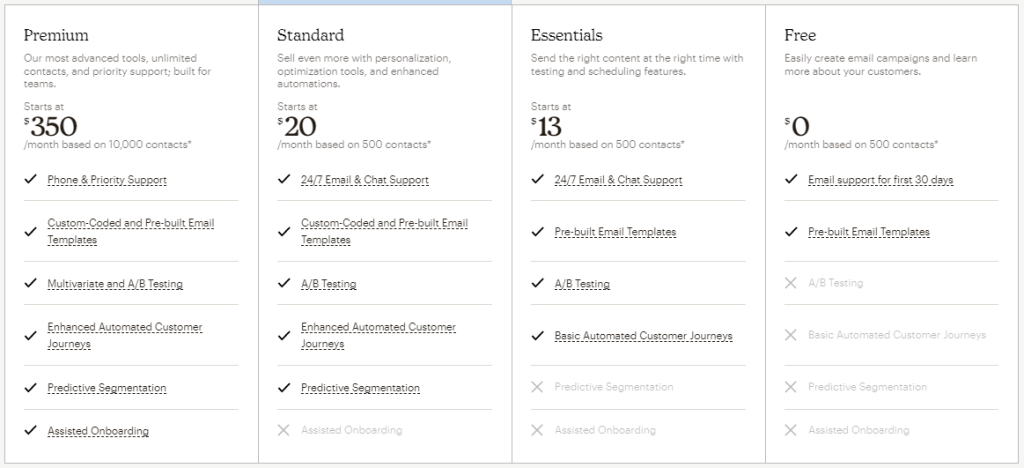
On the other hand, Mailchimp offers a free plan for up to 500 subscribers, and different pricing plans based on the number of subscribers and the level of features you need. For 10,000 subscribers, you will pay $100 on the Essential plan, $135 on the Standard plan and $350 on the Premium plan.
For 500 user:
For 10 000 users:
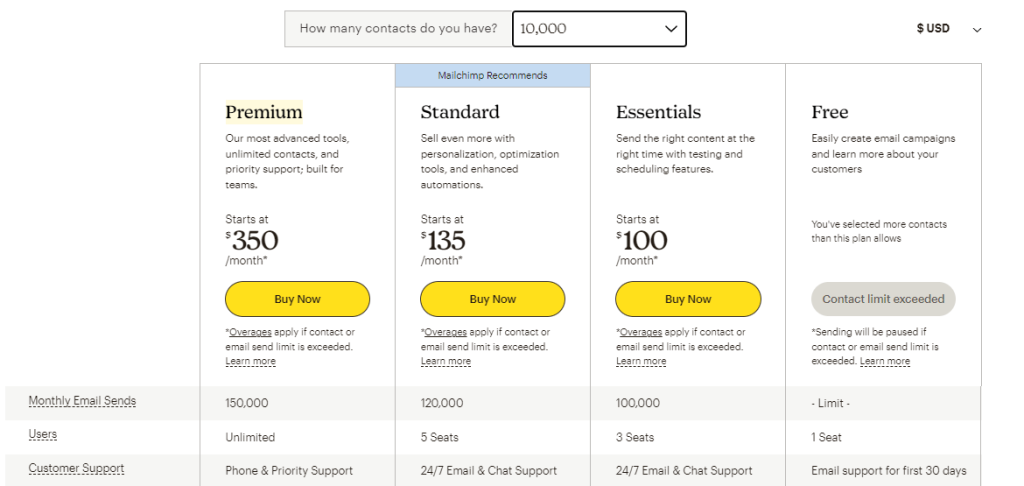
In summary, while both platforms offer different pricing options, Shopify email is more cost-effective for businesses with a small email list, with a free plan that allows you to send 10,000 emails per month. While Mailchimp’s pricing plan offers a free plan for up to 500 subscribers, it becomes more expensive as the number of subscribers increases. For dropshippers with a large email list, Shopify email may be the better choice for its cost-effectiveness.
Integrations and apps
When it comes to integrations and apps, Shopify email offers a major advantage for dropshippers using the Shopify platform. Shopify email is natively integrated with the Shopify platform, which was introduced on November 5, 2019, allowing businesses to easily connect their email campaigns with their e-commerce store. This includes the ability to create targeted campaigns based on customer behavior and purchase history, as well as automated emails triggered by specific actions, such as abandoned cart emails.
On the other hand, Mailchimp can be connected to the Shopify store using the Mailchimp App from the Shopify App Store. This allows businesses to connect their email marketing efforts with other parts of their business and get a more comprehensive view of their customer data. However, it is not natively integrated with the Shopify platform like Shopify email is. It is worth mentioning that Mailchimp stopped working for Shopify on March 22, 2019, due to a disagreement on privacy between the two companies, but it came back on October 26, 2021, and now it can be integrated again via their official app.
In summary, for dropshippers using the Shopify platform, Shopify email offers a major advantage in that it is natively integrated with the platform, allowing businesses to easily connect their email campaigns with their e-commerce store. While Mailchimp can be connected to the Shopify store using the Mailchimp App from the Shopify App Store, it is not natively integrated with the Shopify platform like Shopify email is.
Customer support and resources
both platforms offer a wide range of resources and customer support options to help businesses get the most out of their email marketing efforts. Shopify email offers a comprehensive help center and a community forum, while Mailchimp offers a wide range of resources including tutorials, webinars and an active blog, as well as a community forum and 24/7 customer support which can be reached via live chat, email and phone.
Conclusion
In conclusion, both Shopify email and Mailchimp are solid options for businesses looking to improve their email marketing efforts. Shopify email offers a major advantage in that it is natively integrated with the Shopify platform, allowing businesses to easily connect their email campaigns with their e-commerce store. Additionally, Shopify email offers a free plan that allows you to send 10,000 emails per month, making it a cost-effective option for businesses with a small email list.
Mailchimp, on the other hand, offers a wide range of integrations and apps through its Mailchimp App Store, and it has a free plan for up to 500 subscribers. It also has a wide range of resources including tutorials, webinars, and an active blog, as well as a community forum and 24/7 customer support which can be reached via live chat, email and phone. However, it is not natively integrated with the Shopify platform like Shopify email is, and businesses have to use the official Mailchimp App from the Shopify app store to integrate it with their shopify store.
Here’s a comparison table that summarizes the key differences between Shopify email and Mailchimp:
| Feature | Shopify Email | Mailchimp |
|---|---|---|
| Integration with Shopify | Native | via official App |
| Pricing | Free for 10,000 emails per month | Free for 500 subscribers |
| Additional Integrations | Limited | Wide range through Mailchimp App Store |
| Resources and customer support | Help center and community forum | Wide range of resources including tutorials, webinars and active blog, as well as a community forum and 24/7 customer support |
Overall, the decision of which platform to use ultimately depends on the specific needs and preferences of each business. Shopify email is a great option for businesses that are already using the Shopify platform, and are looking for a cost-effective email marketing solution. On the other hand, Mailchimp is a great option for businesses that are looking for a wider range of integrations and resources, and don’t mind paying for their services.
Our Recommendation for Shopify email vs Mailchimp
In terms of recommendation, we suggest that beginners who are just starting out with their e-commerce business and only need basic email marketing functionality should go with Shopify email. This is because it is natively integrated with the Shopify platform, allowing for easy integration with the e-commerce store, and it offers a free plan for up to 10,000 emails per month.
However, for advanced dropshippers who want more advanced features such as list segmentation and scalability, Mailchimp might be a better option. It offers a wide range of integrations and resources to help businesses improve their email marketing efforts. However, it’s worth noting that other alternatives like Sendinblue and Klaviyo are more user-friendly and offer better pricing plans for bigger lists and more advanced features.
FAQ
Do you need Mailchimp if you have Shopify?
No, you do not need Mailchimp if you have Shopify. Shopify has its own native email marketing feature called Shopify Email, which allows businesses to easily connect their email campaigns with their e-commerce store. However, some businesses may prefer to use Mailchimp for its additional features and integrations.
Why is Mailchimp no longer on Shopify?
Mailchimp was no longer on Shopify on March 22, 2019, due to a disagreement on privacy between the two companies. However, Mailchimp came back on October 26, 2021, and now it can be integrated again via their official app.
Is Shopify email marketing free?
Yes, Shopify email marketing is free up to 10,000 emails per month. After that, emails are charged at $0.001 USD per email.
Why is Mailchimp not good?
Mailchimp is a solid email marketing platform, but it may not be the best option for certain businesses. Some users have reported issues with deliverability, and some businesses may find the platform too complex for their needs.
What are the cons of using MailChimp?
Some of the cons of using MailChimp include a steep learning curve, high costs for businesses with large email lists, and some users have reported issues with deliverability.
Can Shopify email send automated emails?
Yes, Shopify email can send automated emails. It has a range of built-in automation options such as abandoned cart emails, welcome emails, and order confirmation emails.
Can you send emails to non-subscribers on Shopify?
No, Shopify email only allows you to send emails to subscribers.
Is Mailchimp good for ecommerce?
Yes, Mailchimp is a good option for ecommerce businesses. It offers a wide range of integrations and resources to help businesses improve their email marketing efforts, and it is suitable for businesses of all sizes.
Do I need Mailchimp with Shopify?
No, you do not need Mailchimp if you have Shopify. Shopify has its own native email marketing feature called Shopify Email, which allows businesses to easily connect their email campaigns with their e-commerce store. However, some businesses may prefer to use Mailchimp for its additional features and integrations.
Does Shopify use Mailchimp?
Shopify does not use Mailchimp by default. However, businesses can integrate Mailchimp with their Shopify store using the official Mailchimp App, which can be found on the Shopify App store.
How do I set up Mailchimp on Shopify?
Setting up Mailchimp on Shopify is easy. You can follow these steps:
- Install the Mailchimp App from the Shopify App Store.
- Connect your Shopify store to your Mailchimp account.
- Configure your Mailchimp settings, such as syncing your Shopify customer data and setting up automation workflows.
- Create and send your email campaigns directly from your Mailchimp account, and track their performance in the Shopify admin.